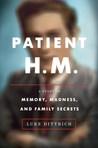
 Patient H.M.: A Story of Memory, Madness, and Family Secrets by Luke Dittrich
My rating: 4 of 5 stars
This book is non-fiction medical writing about neuroscience that touches on the author’s own grandfather, William Beecher Scoville, a famous neurosurgeon and his most famous case, that of Henry Molaison or Patient H.M.
At age 27, Henry and his family agreed to a controversial brain surgery in an attempt to cure his debilitating epilepsy. Henry suffered almost constantly from seizures that completely disrupted his ability to function normally. Dr. Scoville promised relief in the form of a medial temporal lobotomy. The surgery itself was successful, but Henry suffered the devastating side effect of profound short-term amnesia. After the operation, Henry couldn’t remember any new information. He was unable to form any new long-term memories although his past memories were still available to him. As Patient H.M., Henry became one of the most studied individuals in history, and also one of the biggest secrets in the medical world. His existence and identity were closely guarded to protect his from prying eyes, and allow researchers to study him in peace. Through the sacrifice of Patient H.M, researchers were able to break new ground and discover much of what is currently known about human memory.
Times were different in the 1930’s, neurosurgery and the psychosurgeons (as they styled themselves) that practiced it were entering new territory. Lobotomies were in vogue and were intended to cure every type of mental illness from schizophrenia to hysteria (or woman’s troubles).
I found this book fascinating, it is a combination of science, history, memoir and personal revelation. One of the main subjects is a member of the author’s family and during the course of writing the book the author discovered some startling and disturbing revelations about his grandparents. It is impossible for him not to judge his grandfather’s actions through the lens of modern medical thinking, yet, at the time the things his grandfather did seemed eminently reasonable (at least to his grandfather).
In addition, the author presents a wealth of information on the history of neurosurgery all the way back to brain surgery in ancient Egypt and contrasts it to the marvels of the modern day. At times the writing is jumpy and disjointed, but the message comes through loud and clear.
I recommend it to anyone who enjoys the medical writing of Oliver Sachs (The Man Who Mistook His Wife for a Hat) or Rebecca Skloot (The Immortal Life of Henrietta Lacks).
View all my reviews


No comments:
Post a Comment